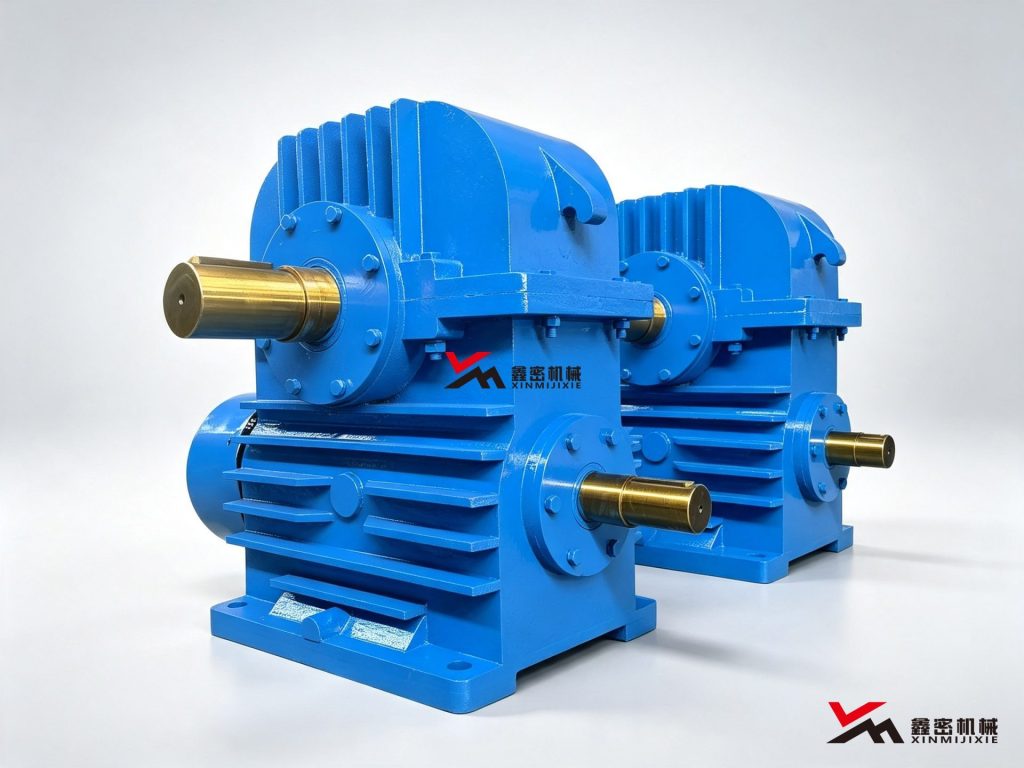
Service life and running stability of worm gear reducers depend heavily on installation and commissioning. Early noise, leakage, abnormal wear, and vibration often result from misalignment, weak foundations, or incomplete commissioning—not product quality. This guide summarizes installation and alignment practice for field teams.
1. Pre-Installation Preparation
- Verification: Confirm model, specification, rotation direction, and interface dimensions; inspect for shipping damage and seal condition.
- Foundation: Mounting base must be flat, rigid, and stable; plane levelness ≤ 0.1 mm/m.
- Tools: Dial indicators, feeler gauges, levels, torque wrenches.
- Lubrication: Fill with specified worm gear oil to mid-level on sight gauge.
2. Installation Steps
- Position and level: Place unit on foundation; level housing with shims.
- Tighten foundation bolts: Uniform torque; recheck level after tightening.
- Input connection: Use flexible couplings to motor—avoid belt or gear connections that impose radial load on input bearings.
- Output connection: Maintain coaxial alignment with driven equipment; prefer flexible couplings.
- Accessories: Install breather, sight gauge, temperature monitoring; ensure vent path is clear.
3. Core Step: Coaxial Alignment
Misalignment is the primary cause of noise, bearing failure, and seal leakage—calibrate strictly.
Dual-indicator method:
- Mount dial indicator on driving shaft; probe coupling OD and face on driven side.
- Rotate both shafts one revolution; record max/min radial and face runout.
- Adjust shims and lateral position until deviation is within limits.
Typical targets:
- Radial runout ≤ 0.05 mm
- Face runout ≤ 0.03 mm per 100 mm diameter
- Higher speed/precision applications need tighter limits
Cautions: Never drive fits with hammers—protect bearings. Key fits per standard—too tight causes stress, too loose causes impact wear. Hand-rotate before power-up; confirm smooth, quiet rotation.
4. No-Load and Load Commissioning
- No-load run: Operate 2 hours; check noise, vibration, leakage; bearing temperature rise ≤ 40°C; verify foundation bolts.
- Load run: Increase from light to full load; monitor oil temperature, noise, vibration. After 2 hours full load, oil temperature stable below 80°C with no noise or leak = acceptable.
- Retighten and recheck: After load test, retorque connections and verify alignment.
5. Common Installation Faults
- Noise/vibration: Check alignment first, then foundation, coupling balance, lubrication.
- Shaft seal leak: Inspect seal installation and wear, breather blockage, overfill.
- Rapid temperature rise: Oil level and grade; misalignment also heats bearings.
FAQ
Q: Is alignment mandatory? A: Yes. Excessive misalignment destroys bearings, seals, and flanks within months—alignment is essential for service life.
Q: Can I belt-drive the input? A: Not recommended. Belt tension creates large radial loads on input bearings. If required, add support bearings and stay within allowable radial force.
Q: When to change oil after installation? A: First change at 300–500 hours to remove break-in debris and protect flanks and bearings.
For field installation and troubleshooting support, contact Dezhou Xinmi Machinery at 13953486612.