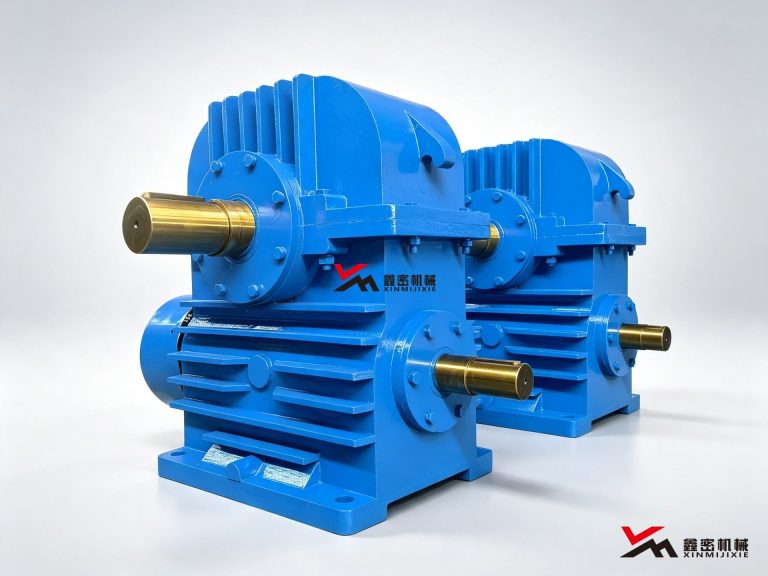
Your bucket elevator needs a 63 mm center distance worm set. The catalog offers 60 or 71. The imported gearbox it came in was discontinued years ago, and the OEM quotes a long lead time for a spare wheel that no longer matches your modified shaft. This is exactly the gap custom worm gear manufacturing fills — and it is wider than most buyers expect, covering everything from one-off replacement sets to long production runs.
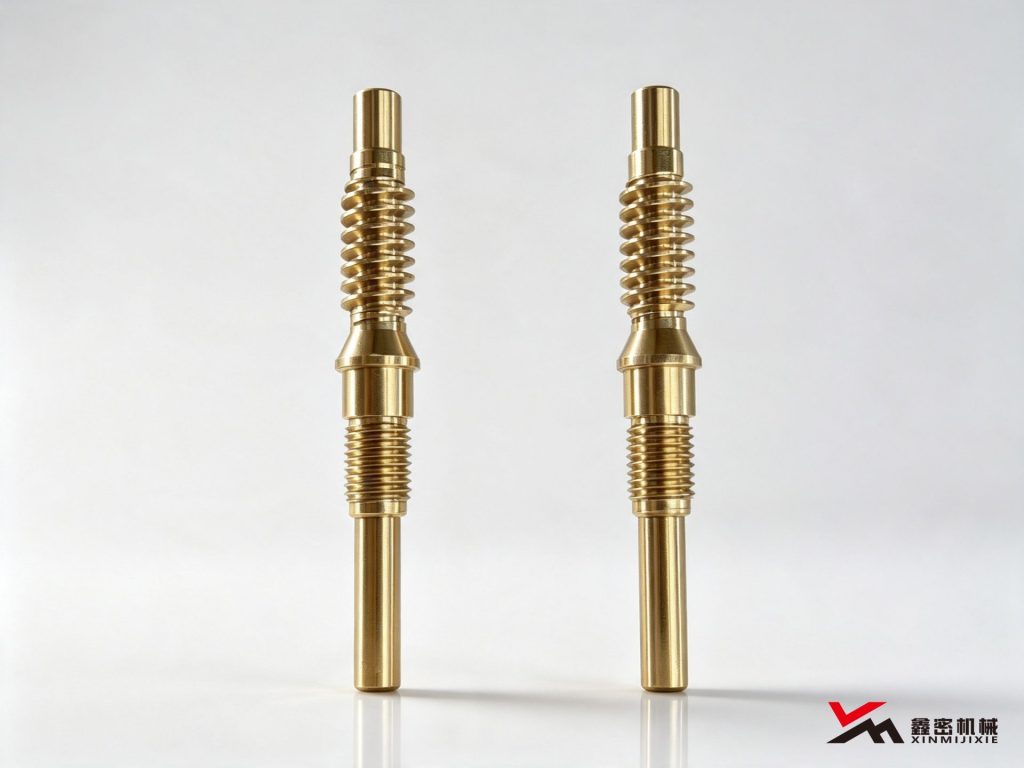
Where Custom Worm Gears Fit: Positioning and Use Cases
Custom worm gearing earns its keep when a standard catalog part cannot. In practice, that happens in four recurring situations:
- Non-standard geometry. A center distance, ratio, or mounting envelope that no catalog series covers, often because the surrounding machine was designed around the gearbox rather than the other way around.
- Duty-cycle mismatch. The catalog unit physically fits, but its rated duty cycle, shock tolerance, or thermal capacity falls short of your actual operating conditions.
- Obsolete equipment. Replacement worm and wheel sets for discontinued imported drives, where the OEM either no longer stocks parts or prices them as a captive product.
- Volume flexibility. Prototypes for design validation, small batches for maintenance programs, and long-series production — all from the same drawings.
One point worth emphasizing: a worm and wheel should be quoted and machined as a matched set. The bronze wheel and the hardened worm share a specific center distance and contact pattern, so mixing a new wheel with a worn worm — or sourcing the two parts from different shops — rarely gives acceptable results.
Key Specs You Must Lock Down Before RFQ
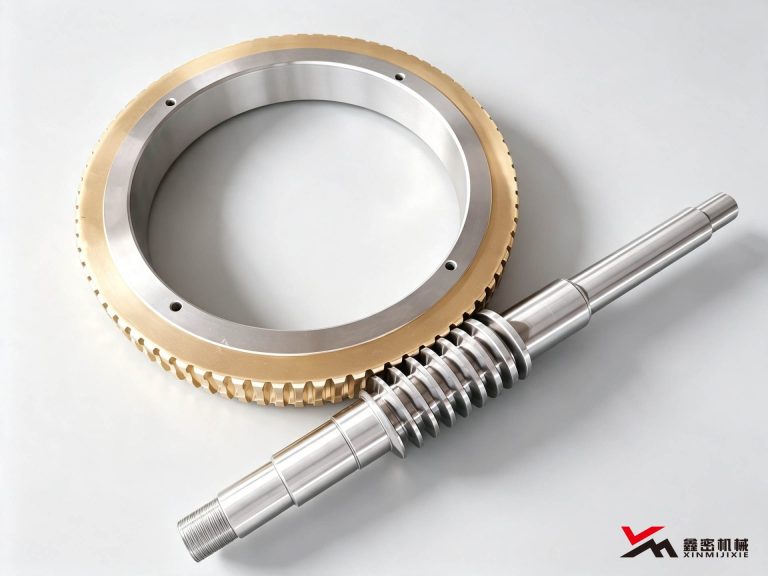
Vague inquiries produce vague quotes. Before you send an RFQ, nail down the following, because each one changes the machining process and the price:
- Geometry: module (m), tooth counts on worm and wheel, ratio (i), and center distance (a)
- Load and speed: input speed in rpm and output torque in N·m, not motor kW alone
- Orientation: worm-over, worm-under, or vertical shaft arrangement — this affects lubrication and bearing loads
- Backlash class: typically specified per DIN 3974, separating positioning drives from power drives
- Self-locking requirement and efficiency target — these pull in opposite directions, so state which one wins
- Operating conditions: duty cycle, shock loading, ambient temperature
- Lubrication method: grease, splash, or forced oil
If you are unsure about any of these, say so in the inquiry. A supplier who asks about your duty cycle before quoting is doing you a favor; one who quotes instantly from a single ratio figure is guessing.
Materials and Heat Treatment Options
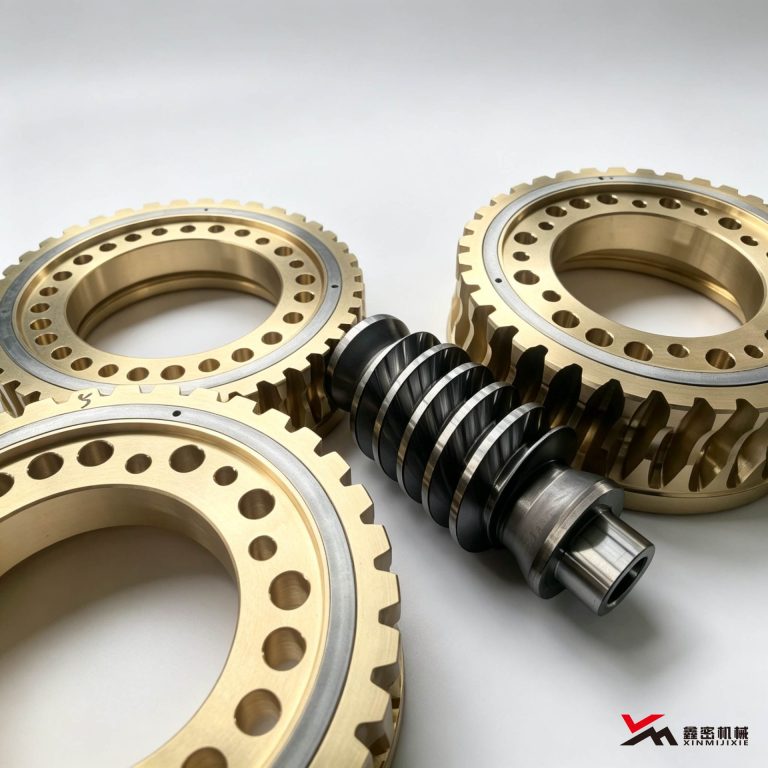
Material selection is where most cost and life trade-offs get decided. The conventional pairing is a hardened steel worm running against a bronze wheel, and the details matter.
For the worm, 20CrMnTi or 42CrMo steel, carburized and hardened to HRC 58–62, is the standard route. Thread grinding after heat treatment achieves tooth finishes to DIN 6 / AGMA 10 grade, which directly reduces mesh noise and extends bronze wheel life. Skipping the grinding step saves money up front and costs it back in wear.
For the wheel, the main options are:
- Tin bronze CuSn10P1 — the default for loaded, continuous-duty sets; best wear characteristics against a hardened worm
- Aluminum bronze — higher strength, often chosen where loads are heavy but sliding speeds are moderate
- Cast iron — acceptable for light loads, slow speeds, and cost-driven applications
Housings are typically HT250 cast iron for rigidity or machined aluminum where weight matters. Shafts and keyways should be sized to the transmitted torque, not scaled from the wheel diameter out of habit.
Worm Gear vs. Helical, Bevel, and Planetary Alternatives
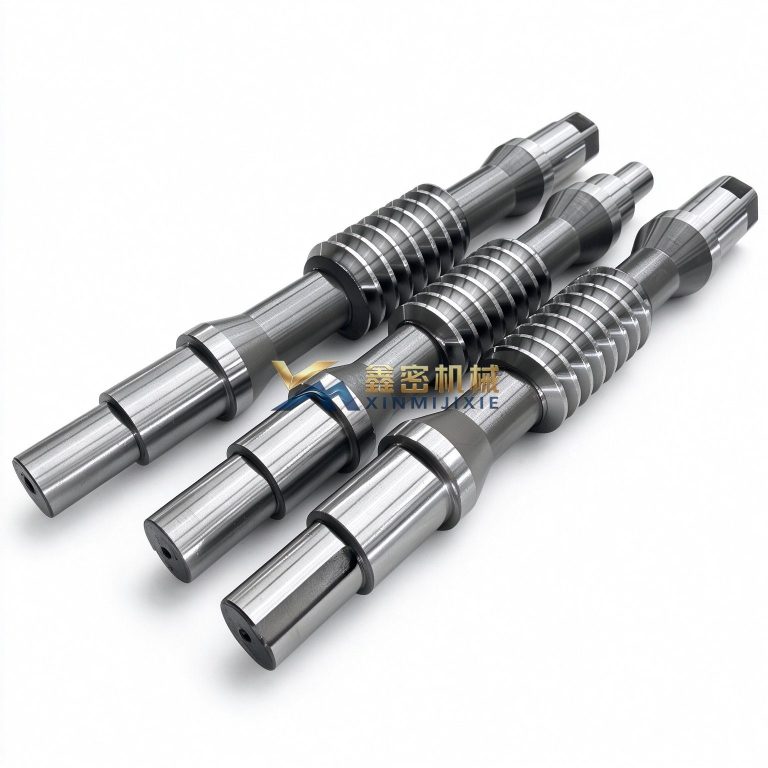
Choosing a worm drive is usually a geometry and safety decision, not a raw efficiency decision. The honest comparison looks like this:
- Single-stage ratios up to 100:1 — a ratio range that would need multiple stages in helical or bevel gearing
- Self-locking behavior when the lead angle stays below the friction angle, which is why worm drives hold loads without brakes in hoisting duty
- Right-angle power transmission with no additional components — the shaft crossing is built into the geometry
- Quiet meshing at moderate speeds, thanks to the sliding tooth action
- Higher torque density than a same-size spur or helical set
The trade-offs are real, though. Efficiency typically runs 50–90% depending on ratio and lead angle, and the sliding contact generates heat that has to go somewhere. Under continuous high-duty operation, thermal capacity — not tooth strength — is often the limiting factor. High-ratio worm sets are also less efficient, so a 60:1 single-stage worm drive and a two-stage helical unit at the same torque are not interchangeable on energy consumption.
Typical Applications Across Industries
The applications where custom worm sets dominate share a pattern: moderate speed, high reduction, right-angle layout, and often a holding requirement. Common examples include hoists and winches, conveyor and bucket elevator drives, valve actuators and damper drives, rotary tables and indexing fixtures, mixers, gates, solar tracker drives, and automotive lifts and material handling equipment.
In valve actuator duty, for instance, the self-locking property matters more than efficiency — the media pressure must not back-drive the stem. In a solar tracker, low backlash and quiet operation at low torque matter most. Knowing which parameter drives your application tells the supplier where to spend the machining budget.
Factory Capabilities That Separate Real Suppliers
Anyone with a hobbing machine can claim to make worm gears. A shop that can actually control the result will have most of the following:
- Machining: CNC hobbing, thread grinding, and worm milling — thread grinding is what separates precision sets from as-cut ones
- Centrifugal casting for bronze wheel blanks, giving denser, more consistent material than sand casting
- Gear rolling testers and single-flank inspection to verify contact pattern and transmission accuracy on the finished set
- CMM, hardness, and surface roughness verification on a per-batch basis
- Heat treatment in-house or through certified partners, with hardness reports to match
- Traceability: batch numbers, material certificates, and hardness reports tied to each delivery lot
Ask specifically how the supplier inspects the worm thread profile and how they match the set. If the answer is vague, the contact pattern will be too.
How to Inquire: Selection Checklist
A complete inquiry shortens the quoting cycle and eliminates the back-and-forth that stalls most projects:
- Prepare 2D drawings plus a 3D model — STEP format is preferred
- State torque, speed, ratio, and daily run hours
- Specify the backlash class and noise target
- Confirm the bronze grade and worm hardness requirement
- Ask for a first-article inspection (FAI) report before series production
- Clarify MOQ, tooling cost, and repeat-order lead time
- Agree on packaging, rust prevention, and shipping terms
FAQ
What lead angle is needed for self-locking?
As a rule of thumb, self-locking is reliable below roughly a 5° lead angle, but the actual threshold depends on the friction coefficient and surface finish of the mesh. More importantly, verify behavior under vibration, not static load only — a set that holds still on the bench can creep under a vibrating load.
Can you reverse-engineer a worn worm gear set?
Yes, from a sample or even broken parts. The shop measures center distance, tooth profile, and material, then confirms the reconstructed dimensions against the mating housing before cutting. This is routine work for obsolete imported drives where drawings no longer exist.
What backlash grade should I choose?
Use DIN 3974 classes to separate positioning drives from power drives. Tighter backlash raises grinding cost significantly, so match the grade to the positioning accuracy the application actually needs. Over-specifying backlash is one of the most common ways to pay for precision nobody uses.
How do you control noise and wear?
Three levers: matched-set grinding of the worm and wheel, correct bronze grade and surface finish, and the right lubricant viscosity for the duty cycle. Get all three right and a worm set runs quietly for years; miss one and the wheel wears fast regardless of the others.
What is a realistic MOQ for custom sets?
It depends on tooling and the bronze casting batch size. Standard module cutters reduce setup cost considerably, and prototype runs are usually negotiable before a series order. Ask the supplier which standard tooling your geometry can use — sometimes a 0.5 mm change in module doubles the price.
Send Your Drawings for an Engineering Review
If you have a worm gear set to quote — new design, worn sample, or obsolete import — send the drawings or a 3D model along with torque, speed, ratio, and daily run hours. An engineering review before quoting will flag manufacturability issues, confirm material and heat treatment options, and give you a realistic picture of tooling cost and lead time. NDA coverage is available for proprietary designs, and prototype or small-batch trials can be arranged before series production.